Educational and independent — not medical advice, and no one paid for any conclusion on this page.
Gynecomastia surgery cost: the independent all-in guide
Published averages contradict each other because nobody prices the whole thing. Here's the honest all-in math — surgeon, anesthesia, facility, garments, time off — with no clinic to sell you.
The short answer
Most men in the US pay roughly $4,000–$8,000 all-in for gynecomastia surgery, with big-metro, skin-removal, or top-specialist cases running $10,000–$13,000+. Published 'averages' disagree wildly — a widely cited ~$4,100 figure counts the surgeon's fee only, while fully loaded quotes of $9,500–$13,000 include anesthesia, facility, and aftercare. Always compare what's bundled, not the headline number.
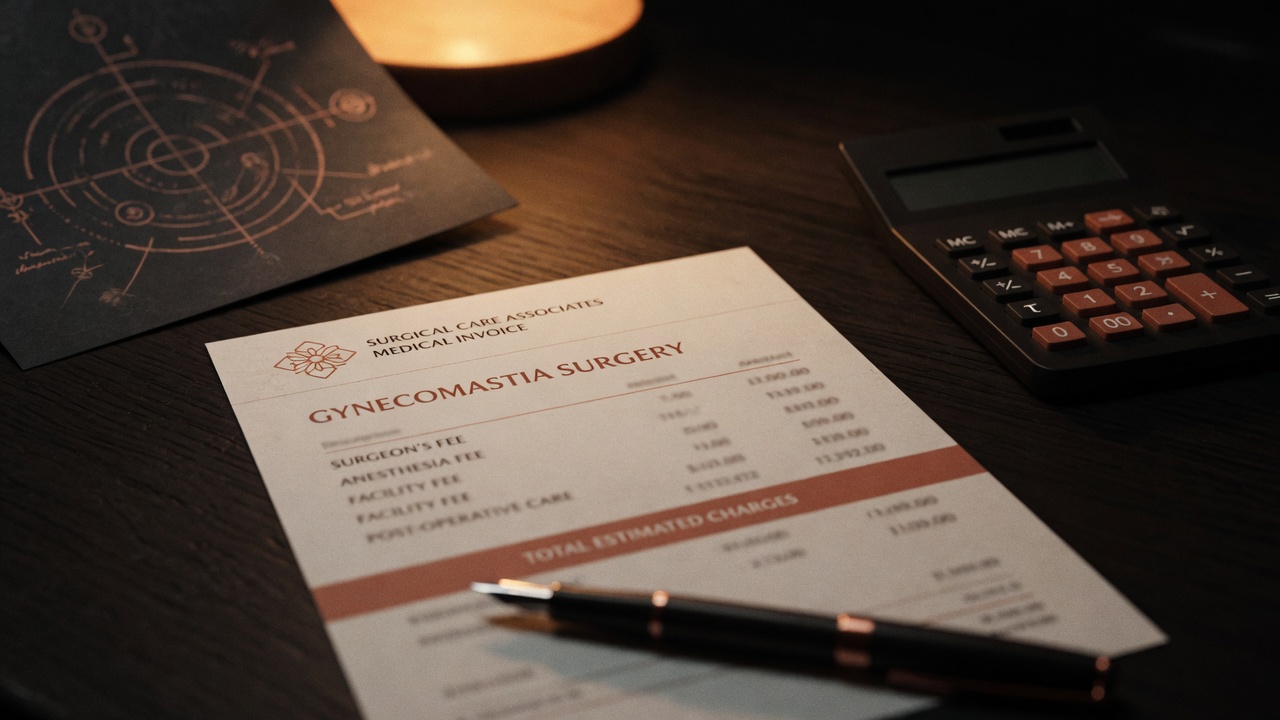
Search the cost of gynecomastia surgery and the numbers contradict each other instantly: an often-quoted "average" around four thousand dollars sits next to real quotes of ten thousand or more. Both are real. They are measuring different things. This guide prices the whole thing — every line that ends up on the invoice and the ones that never appear on any invoice — with no clinic on the other end of it.
Why the published numbers disagree
The famous low "average" counts the surgeon's fee only. A real bill stacks five or six lines on top of each other:
- The surgeon's fee — the number most averages quote alone.
- Anesthesia — anesthesiologist or nurse anesthetist, billed by time.
- The facility — operating room and recovery, billed by the hour.
- Compression garments — one or two vests you will live in for weeks.
- Follow-ups and supplies — sometimes bundled, sometimes not.
- Pathology, if excised tissue is sent for routine examination.
A quote is only comparable to another quote when you know which of these it includes. "All-in" from one surgeon can genuinely cost less than a lower headline number from another once the extras land. The single most useful sentence at any consult is: "Can I have the all-in figure, in writing, with what it includes?"
The honest ranges
Prices men commonly report, as ranges rather than promises — your grade, your city, and your surgeon's volume move every one of them:
- United States: roughly $4,000–$8,000 all-in for standard lipo-plus-excision, rising to $10,000–$13,000+ in major metros or when skin removal is involved.
- United Kingdom: commonly £3,500–£6,500 privately.
- Turkey: package quotes of roughly $2,500–$4,500 are typical; what "package" covers varies enormously.
- India: often $1,500–$3,500 at reputable private hospitals.
- Thailand and Mexico: commonly $2,500–$5,000.
↳ Next step
Compare real all-in prices on the cost mapUS specialists and international clinics side by side, with all-in figures — no surgeon can pay to appear in the directory.
Grade moves the number more than geography within a country: skin excision (grades 3–4) adds operating time, anesthesia time, and aftercare everywhere on earth. Our live cost map tracks practice-published figures next to what men actually paid — the gap between those two numbers is worth more than any published average.
The quote that is suspiciously low
A cheap quote is often cheap because something is missing — and the most expensive thing that goes missing is the operation itself. Lipo-only offered for a chest with a firm gland is the classic pattern behind "I paid and it looks the same": liposuction cannot remove glandular tissue, and redoing it properly later costs more than doing it once. Before comparing prices at all, confirm the same operation is being quoted: does it include gland excision? Skin, if your grade needs it? Revision policy if it does not settle right?
The most expensive surgery is the one that has to be done twice.
Insurance, financing, and the revision reserve
Insurers almost always classify this as cosmetic; coverage happens, but only occasionally, with documented pain or an underlying condition, and never by assumption — get your plan's criteria in writing before planning around it. Financing (medical credit lines, clinic plans) spreads cost but adds interest; HSA/FSA eligibility varies and is worth a direct question to your administrator.
And the line nobody budgets: a revision reserve. Most men never need it. The ones who do are very glad it exists. If a revision would financially wreck you, that is worth knowing before the first operation, not after — it may change which surgeon, which country, or which year makes sense.
↳ Common questions
How much does gynecomastia surgery cost?
In the US, most men pay roughly $4,000–$8,000 out of pocket, with a full range of about $3,000 to over $10,000 depending on city, surgeon, technique, and whether skin removal is needed. Always ask what the quote includes — anesthesia, facility, garment, and follow-ups are sometimes billed separately.
Does insurance cover gynecomastia surgery?
Usually not — most insurers classify it as cosmetic. Coverage is occasionally possible with documented pain, a suspected underlying condition, or failed medical treatment, but approval is the exception. Don't assume; get your specific plan's criteria in writing before you plan around it.
Why do gynecomastia surgery quotes vary so much?
The biggest drivers are the surgeon's experience, your grade (skin removal costs more than gland excision alone), anesthesia type, and geography. A higher quote isn't automatically better — but a suspiciously low one often excludes things you'll be billed for later. Compare what's bundled, not just the headline number.
↳ Sources
- American Society of Plastic Surgeons — procedure statistics and average surgeon's fees
- Published US clinic and aggregator price ranges, surveyed June 2026 (full reconciliation table in the article body)
↳ Next step
Compare real all-in prices on the cost mapUS specialists and international clinics side by side, with all-in figures — no surgeon can pay to appear in the directory.
↳ See it on real men
Cases that fit what you just read